Archive | Uncategorized RSS feed for this section

Inkweed

24 Apr

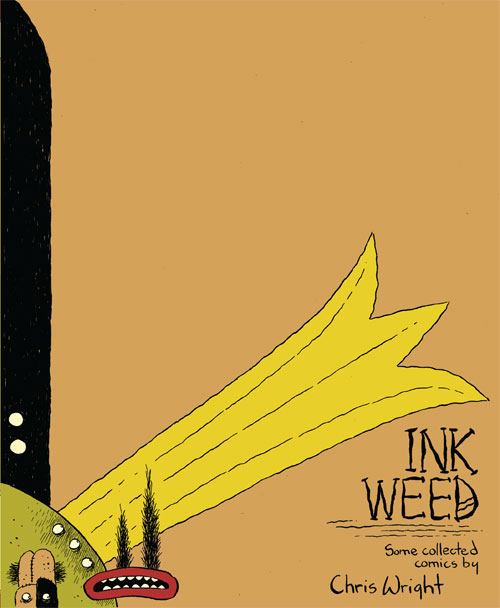
Copyright Chris Wright

During an excellent interview about his debut book, Inkweed, author Chris Wright poses the question, “Is restraint a virtue?” Though the quote refers to one story from the collection in particular, that same questioning can be applied to all of Wright’s ambitious work. With his bizarre visual style, philosophical themes, and literary dialogue, his work shows a bold inventiveness and an overriding desire to elevate the medium of comics to an unprecedented level, even at the risk of alienating some readers.

Inkweed is a collection of short works produced between 2002 and 2007, yet the book feels more like a unified whole than a hodge-podge of unrelated stories. The works range from 15-20 page stories to single-page drawings, but the same high level of quality is consistent. Themes like an obsession with art, the nature of existence, despair, and futility recur throughout the book and simultaneously tie the works together and give us a glimpse into Wright’s mind and his own artistic goals.

The first thing a new reader will notice about Wright’s work is his distinctive drawing style; his characters are mostly humanoid but with distorted figures and features, their bodies often distorted to match their personalities, and the distortions are more extreme in the shorter pieces. Just as intriguing is the fact that his female characters lack all this distortion; aside from some slight stylization, they appear almost human.

Many of the stories in Inkweed feature characters at the end of their lives, reflecting on what’s come before and what’s left for them. The characters are well-written and very convincing, and this is made all the more remarkable by the fact that Wright was in college and his early 20s when he drew these stories.

Inkweed isn’t for everyone, there’s no doubt about that. But if this sounds like something you’d like, I guarantee that it’s something you’ll love. This book has really changed the way I think about comics, and art in general, and I’d say this is essential reading for anyone interested in creating. Also, be sure to keep an eye out for Blacklung, Wright’s first full-length book, which is finally being published after years of difficulty with publishers, and which received a particularly glowing advance review. (I’m pre-ordering a copy)

Happy reading,

-Nate
Vagabond

16 Apr

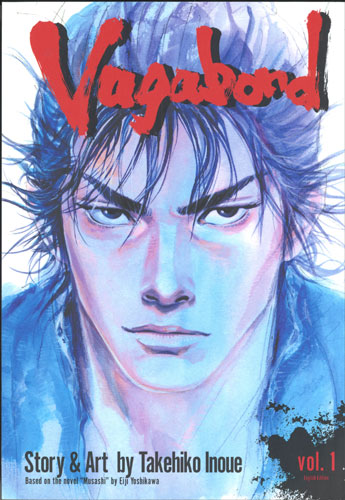
Copyright Inoue Takehiko

When you hear the word “manga,” what comes to mind? Wide-eyed characters shooting laser beams at each other? Giant robots battling in space? Creepy fetishistic nonsense? While those sorts of series are part of the manga spectrum, it seems that most Americans are under the impression that that’s all there is to manga, and as a result they overlook many of the gems to be found. Inoue Takehiko’s Vagabond is one of those gems. With its superb artwork, engaging storytelling, and subtle characterization, Vagabond is a raw, visceral, and emotional look at the life of Miyamoto Musashi, and is hands-down one of the best comic series I’ve come across.

One of the prominent figures in Japanese history, and one of the best-known overseas, Miyamoto Musashi was Japan’s most famous samurai and arguably one of the greatest warriors in the history of the human race. Musashi lived in the early 17th century, and spent the better part of his life traveling around Japan seeking out and challenging the strongest swordsmen to perfect his own skills. He is best known as the founder of the niten-ryu school, notable for its two-sword techniques, and as the author of the popular Book of Five Rings, a treatise on philosophy and strategy. Miyamoto has been the subject of dozens of movies, books, video games, and TV shows, one of the most famous being Eiji Yoshikawa’s massive epic (the US abridged version is over 900 pages) Musashi, a fictionalized account of the samurai’s life. Vagabond, in turn, is loosely based on Yoshikawa’s novel, and its author Takehiko Inoue has made many bold claims about his manga standing on equal footing with the acclaimed novel. The numerous awards given to Inoue for Vagabond, including the prestigious Tezuka Osamu Cultural Prize, seem to support his claims.

Vagabond begins shortly after the infamous Battle of Sekigahara, which 17-year old Musashi and his childhood friend Matahachi have managed to survive. The two quickly find themselves pursued by the forces of the victorious side, and are soon fighting for their lives as they’re forced to find a new direction for themselves following their army’s defeat. From there we’re able to watch as the wild and ruthless Musashi grows into the legend he’s known as today.

When compared to the image most have of Musashi, the disciplined and refined master of his later years, his appearance at the beginning of series is quite striking. When we meet him he is a wild and bloodthirsty youth with an almost unnatural strength and the ability to kill without hesitation. Matahachi, on the other hand, is the perfect foil for Musashi; his sensitive nature and cowardice cast Musashi in alternatively admirable and despicable lights, and show just how far away from most humans Musashi is. The ways in which these two characters change is really intriguing, and I found myself changing my opinion of them, as well as the various other characters, quite often.

Inoue’s art does a brilliant job of bringing the world of feudal Japan to life and drawing his readers into that world. His rich, detailed drawings are filled expressive faces and evocative scenery. The many battles in the series are quick and brutal, often coming at you like a punch to the throat. Many times in intense moments Inoue will shift to a much rawer style, with blots of ink reminiscent of Japanese ink paintings. Yet for a series so filled with violence, Inoue never glorifies it. The violence is shown for the senseless waste that it is, and it isn’t long before Musashi himself begins contemplating the implications of his disregard for life.

While the manga certainly rewards those with some knowledge of Musashi and his life, prior knowledge is absolutely unnecessary to enjoy the series, and I’d even recommend this to those with no prior interest in Japanese history. The ongoing series has just reached its 33rd volume, so there’s plenty to enjoy, and all the volumes are available in an English translation. If you only read one manga series in your life, read One Piece. If you read two, make the second Vagabond.

Happy reading,

-Nate

(Background info via Wikipedia)

Back from the dead

13 Apr

Well, it’s been a long six months or so, with plenty going on to keep me away from this blog. Since my last post I’ve moved to Japan, which, as you can imagine, makes it much harder to get American comics, and much, much easier to get Japanese comics. So that said, and taking into account my full-time job, I’ll be changing the format of the blog a bit. Or rather I should say getting rid of it. I’ll be shooting for one or two posts a week, but it will be more when I have something to write, instead of burning through comics (and money) to meet a post quota. Plus I’ll still have webcomic reviews now and then, so it won’t be too much different. I figure a week gap between posts is better than six months, so if you’ll have me back I’ll be right here. Look for my next review within the next day or two!

-Nate

Favorites Friday – The Unwritten

28 Oct

Copyright Carey and Gross

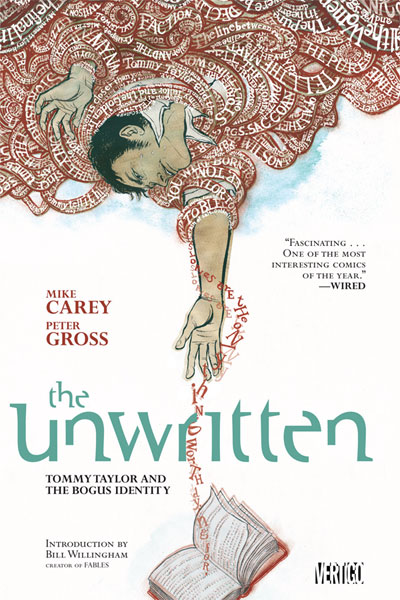
What’s the effect that stories have on our lives? If something fictional has a profound effect on humans, can’t we say that it’s, in a sense, “real?” Questions like this are by no means new, and have been addressed in all sorts of media, but one of the finer examples is the excellent comic series The Unwritten.

Written and illustrated by Mike Carey and Peter Gross, the team behind the acclaimed Lucifer, The Unwritten weaves a suspenseful tale that blends the worlds of reality and fiction and looks at the stories we tell as individuals, cultures, and as a race. In the world of The Unwritten, the most popular books are the “Tommy Taylor” series, a story about a young wizard that closely (and intentionally) mirrors that of Harry Potter. The worldwide phenomenon is further fueled when the series’ author, the reclusive Wilson Taylor, mysteriously disappears before finishing the series. His disappearance shifts focus to his unfortunate son, Tom Taylor, the namesake and basis for the books’ main character. Tom makes his living attending conventions and signing autographs, but nonetheless hates the attention and the way people associate him with the fictional Tommy Taylor. All this changes, however, when Tom is attacked by the main villain of the series (a vampire) and is later framed for a murder, forcing him, along with two companions, to go on the run and discover what exactly is happening to them. Along the way the three travel through various fictional worlds and start to discover the secrets of a dark organization that controls the world’s stories.

A big part of The Unwritten‘s appeal for me is the plethora of literary references scattered throughout the books. Many of them are just incidental and have no real bearing on the plot, but will definitely get a grin from those who are in the know. In some cases the references are a bit more central to the plot, but never enough to detract from the enjoyment of someone who’s unfamiliar with the allusion. There’s one instance in particular that had me laughing out loud, but I won’t say more than that; if you read this you’ll know what I mean. The writing as a whole is absolutely solid, and with plenty of twists that will surprise you every time.

To be honest, I’m still a little torn on the art. It definitely gets the job done, but there are some days I really like it, and some days I really don’t. The covers for the individual issues, though, are absolutely gorgeous, and while reading the trade paperbacks it’s always a treat to get to the next issue. One last bit about the art, because it’s so darn cool: the third paperback volume includes a really ingenious “Choose Your Own Adventure” portion, which works surprisingly well in a comic format, and seeing them pull it off so skillfully is as enjoyable as the story itself.

If you’re a book fiend, make this the one series you start reading this year. Even if you’re not, there’s still a lot here to like, and The Unwritten is absolutely worth your time.

Happy reading,

-Nate

Favorites Friday – Sweet Tooth

21 Oct

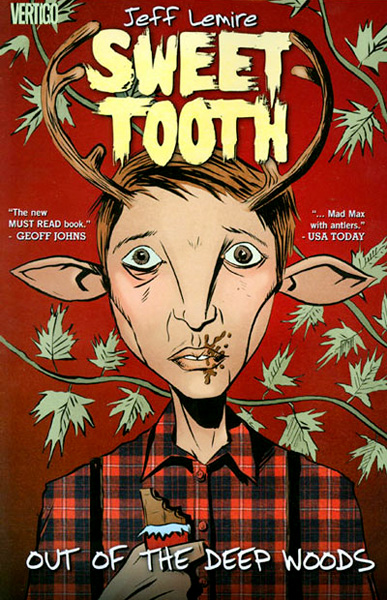
These days, the post-apocalyptic story has been pretty much done to death, which is what makes Jeff Lemire’s Sweet Tooth all the more surprising. Set in the years after a global plague has wiped out most of humanity, Sweet Tooth follows a young boy as he ventures out from the relative safety of his home into the barren wasteland. Oh, and he happens to have antlers and fur.

For reasons scientists have yet to comprehend, all children born after the outbreak of the plague were bizarre human-animal hybrids. Moreover, these new hybrid children are apparently completely immune to the plague, which leads to some new conflicts…Ok, that’s all you’re getting.The main character is the aforementioned deer-boy named Gus, who at the start of the story leaves the immediate area around the house where he grew up, with no idea of what has been happening in the outside world. His sheltered optimism and understandable confusion at what he sees, when contrasted with the cynicism of the few survivors, forms one of the main conflicts of the series.

Jeff Lemire has such a distinctive art style, and it perfectly complements the grim tone of the comic. His rough, inky lines will be familiar to fans of the excellent Essex County Trilogy (which I’ll probably review in the near future), and his abilities have only grown stronger since that series. Though his art can look rough or sketchy at times, it’s also clear that he’s always in total control of his art, and the pages look exactly how he wants them to. His expressions are top-notch, too; nobody draws sadness like Lemire, and Sweet Tooth has plenty of it to go around. The series isn’t all doom and gloom though; it’s the glimmers of irrational compassion that make the story really worthwhile. The story is also going in some really interesting places, and I’m excited to see where he ends up taking it.

The characters are great, the art’s great, and the concept is unique. Plus the volumes are pretty inexpensive, so go pick it up!

Happy reading,

-Nate

Webcomic Wednesday – Bearmageddon

19 Oct

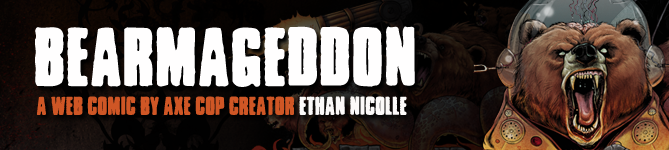
I discovered Bearmageddon when I was reading Axe-Cop, and even though it just started in August, I still thought it was worth sharing. Bearmageddon is written and drawn by Ethan Nicolle, the same guy who draws Axe-Cop, and the similarities between the two comics are apparent right from the start.  There are even some subtle references to Axe-Cop for fans of the series, so keep an eye out. All that said, this is by no means a little “side project;” this is a very well-done comic that would easily stand on its own without the connection to Axe-Cop.

I’m sure you’ll be able to guess the gist of the story from the title; in a nutshell, the impending world domination by grizzly bears led by a group of super-bears. What isn’t as easy to guess from the title is the excellent characterization Ethan accomplishes, as well as the clever and subtle ways he weaves in a tension between nature and society, which is shaping up to be a major theme for the comic. A story about pissed-off, super-intelligent bears would be cool, but since it’s a lot easier to relate to humans, making it a story about humans dealing with pissed-off, super-intelligent bears was probably the right choice. So we’re introduced to Joel Morely, a 22 year-old working a lousy job at Wow Mart and living at home with his younger brother and overbearing father. Joel’s friends are all just as unmotivated as he is, and this leads to a pretty ingenious plot point that I won’t say anything else about (he’s only on page 22). Ethan manages to perfectly capture the slump that so many young adults find themselves in, just getting by day-to-day and unable to make the leap from adolescence to adulthood. The characters sound and act like young twenty-somethings, and I have a feeling most people can relate to them in some way.

Ethan has said that Bearmageddon is a graphic novel, and as such will not go on indefinitely. This definitely shows in the very focused, foreshadowing-heavy storytelling he uses, and it’s a nice change of pace for an online comic. Also, one more little thing that really impressed me: under the “Characters” tab on the site, in addition to the main characters, Ethan has given extensive descriptions for characters that (so far) have appeared only once and are never referred to by name in the story. He was probably just doing it as a gag, but even so it’s great to see that he recognizes that these characters, however minor, have their own stories, and by giving them their stories the comic as a whole benefits.

Anyway, I don’t want to say too much more since it’s so short at the moment, but it’s also a good reason for you to go read it. You can get caught up in about 20 minutes, and then when this becomes a hit you can brag to all your friends that you’ve been reading it since (almost) the beginning.

Happy reading,

-Nate

Misc. Monday – Power Drive A

17 Oct

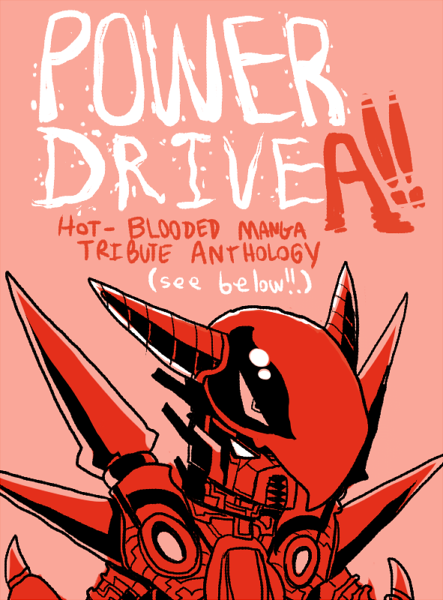
If you know me, you know that my associate Zach and I like to make comics. Recently, a friend of ours recommended we check out Power Drive A, a comic anthology in the works. It’s a self-described “hot-blooded manga tribute anthology,” and should end up being pretty badass. So Zach and I have decided to make a contribution to the anthology, which of course is more reason why you should check it out.

If you make comics, or like to draw and have thought about making comics, this would be an awesome place to start. Submissions can be between 2 and 10 pages long, and all contributors will receive a portion of the profits from sales. If you don’t make comics but you think this sounds cool, then check it out! The deadline for submissions is March 25, so the book won’t be out for a while, but I’ll post on here when it comes out. The original info post has more details, and people are already posting some really cool character designs on tumblr, so this will definitely be one to look into. That’s all for today, remember to check back Wednesday for this week’s webcomic.

Happy reading,

-Nate

Favorites Friday – Chew

14 Oct

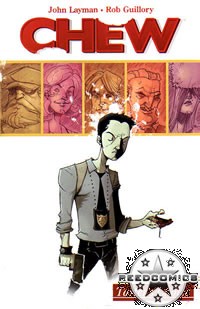
Copyright John Layman and Rob Guillory

In honor of the fourth volume being released, I thought I’d review Chew, a recent favorite of mine and one of the cleverest series out there. Chew follows the exploits of Tony Chu, an agent for the FDA who happens to be a cibopath, or a person who gets psychic impressions from the food that he eats. Tony uses this bizarre power to solve crimes, which often involves eating a small piece of a dead body, much to his chagrin.

The writing in Chew is top-notch, and every volume has me laughing out loud the whole way through. That said, the story doesn’t take a back seat to the jokes, and it’s impressive how over the span of the issues so far Layman has woven together an intricate story of intrigue, government conspiracies, betrayal, and, of course, food. Chu and the other strange people that populate the world of Chew are all excellent, each with their own quirks and foibles. It’s hard to find such multifaceted characters in a comedy series, but Chew absolutely delivers.

More than the humor, the big selling point for me is the series’ art. The dark yet cartoony art is perfect for the story’s dark humor, and the colors are just awesome. Guillory often uses color screens to help set the mood in scenes and it’s just so cool. Plus his work on the characters does a lot to make them even fuller, with some really priceless expressions and physicalities.

Chew only started in 2009, and it’s already won a boatload of awards and has been getting a lot of buzz. So what are you waiting for? A TV adaptation is supposedly in the works, so if you go read the comic now you can complain about the show when it comes out.

Happy reading,

-Nate

Webcomic Wednesday – MS Paint Adventures

12 Oct

In my review of Dresden Codak, I talked about how that comic is taking advantage of some of the unique properties of the Internet as a medium, namely the unlimited canvas of webpages. Another comic that takes this one step further is MS Paint Adventures, one of the most original comics I’ve seen.

The basic concept of MS Paint Adventures is that the various comics on the site essentially mimic the “Choose Your Own Adventure” books and old text-based video games. Originally, readers would give suggestions for what the character in the story should do next by means of a forum, and the comic’s creator, Andrew, would then choose the first suggestion given to advance the story. The first two comics, “Jailbreak” and “Bard Quest” both followed this format, and also had branching story paths. However, Andrew considers them “failed experiments,” and they both remain unfinished.

For the first major story on the site, “Problem Sleuth,” he did away with the branching storylines and the forum-based suggestion method, and switched to a suggestion box, giving him a list of suggestions he could choose from. After finishing “Problem Sleuth,” which is several thousand pages, he started “Homestuck,” which is currently running, is very long, and also incorporates flash animation, interactive pages, and music. The site’s fanbase is so huge now that Andrew admits it’s hard to still call it “reader-driven,” as there are so many suggestions coming in at any given time.

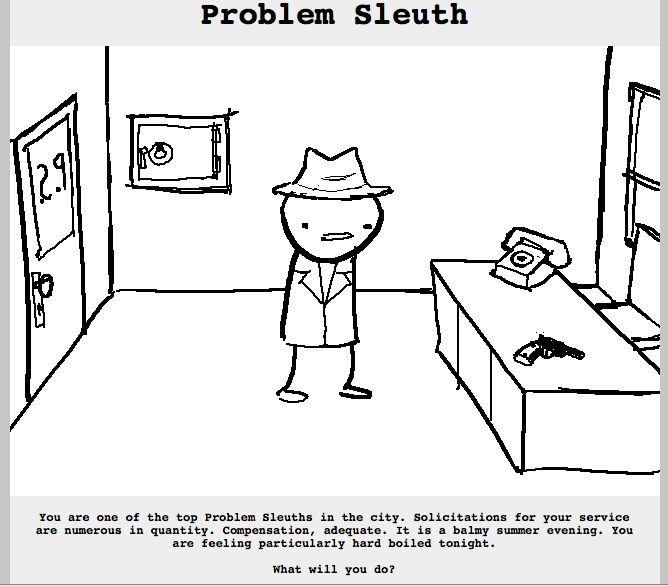
So now to the actual content. As the title would tell you, all of the pages (excluding the flash effects) are created in MS Paint, so naturally they don’t look too great. The characters in “Problem Sleuth” are stick figures, and many of the objects are pretty crudely drawn. There are occasionally very well-drawn props though, and the contrast in detail when these things show up (I’m being intentionally vague) provides a good bit of humor. Nevertheless, the simplified art style allows for much faster updates, sometimes even multiple updates in one day.

First page of "Problem Sleuth." Copyright MSPaintAdventures.com

The comics also have a very unique humor, a lot of which comes from toying with readers’ perception of items in the “game’s” world. I won’t give anything away, just know that nothing is what it appears to be, and it looks like Andrew had a lot of fun twisting peoples’ suggestions. There are also a lot of recurring jokes and themes, so the comic only gets better as it goes along.”Homestuck” even has a webcomic-within-a-webcomic, “Sweet Bro and Hella Jeff,” which is absolutely hilarious and is worth checking out even if you never read the rest of MSPA.

I’m most of the way through “Problem Sleuth” and still pretty early in “Homestuck,” but both are great in their own ways, and are both worth taking the time to read. I’d suggest starting with “Problem Sleuth” before moving on to “Homestuck” or checking out the earlier two (though “Bard Quest” is pretty funny). So go check them out, they’re a lot of fun!

Happy reading,

-Nate

Misc. Monday – Panel Bound

10 Oct

Hey everybody, today I came across this pretty cool blog, Panel Bound. It focuses on indie comics, and one of its main features is the interviews with different comic artists, including Rice Boy‘s Evan Dahm. They also feature reviews, and it looks to be a cool place to discover new series (like this, right?) So go check it out, and then check back here on Wednesday for this week’s webcomic review.

Happy reading,

-Nate