Archive | Uncategorized RSS feed for this section

Favorites Friday – The Goon

7 Oct

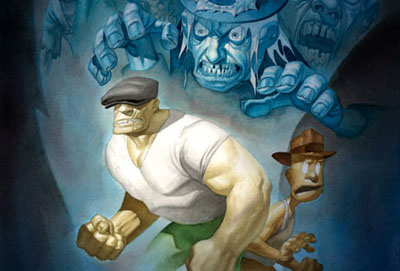
The Goon and Franky. Copyright Eric Powell.

When I was first starting to stray from the realm of superhero comics, one of the first series I randomly picked to try out was Eric Powell’s The Goon. If I had known then what a lucky find it would be, I would’ve bought all the volumes the store had and read them all in the parking lot. Simply put, The Goon is one of the best series I’ve ever come across: no gimmicks, just outstanding writing, gorgeous art, and some of the best humor out there.

Set in Depression-era America, The Goon introduces us to the hulking mob enforcer known only as Goon, his foul-mouthed and knife-crazy right-hand man Franky, and the rest of the motley crew that populates the nameless town. When he’s not beating protection money out of people around town, he’s fighting off the hoards of zombies and other bizarre monsters that have started showing up. Up until about Volume 5, the issues are for the most part stand-alone stories, with hints at a bigger picture that begins from Volume 7.

One of the hallmarks of the series, and one of its funniest aspects for me, is the excellent dialogue, a goofy caricature of 1920’s slang. The characters are also often overheard telling bizarre anecdotes, usually involving strange bets, Franky’s love of overweight and/or elderly women, and the overall weird occurrences that characterize the town. There are inflatable chickens, a giant Spanish-speaking lizard, hallucinogenic dream sequences, and much much more! Powell’s brand of humor is so distinct that the various tributes to the comic feel like they could’ve been written by Powell himself (a short story by Thomas Lennon, Reno 911’s Officer Dangle, is one of the highlights of the series).

That said, the goofy dialogue and crude humor belie a surprising amount of depth in the series, especially with the character of the Goon. While at first he seems like nothing more than a musclebound simpleton, it isn’t long before we’re shown hints of a tortured past and an impressive shrewdness. Franky, on the other hand, is the perfect foil to Goon: while the Goon tends to be quieter and pensive, Franky is always making himself heard; while the Goon is fixed on a woman from his past, Franky is always out chasing tail. Add to all that the hint that Franky’s behavior serves to hide a deeper sense of vulnerability, and you’ve got yourself some first-class writing. Scattered throughout the series are little moments when the two characters let their guard down and we see just how deep their friendship and loyalty lie, and these moments are really stunning, to say the least. Volume 6, “Chinatown,” gets tossed around as a high point for the series, and for good reason: the book that explores Goon’s tragic past is a prime example of Powell’s masterful portrayal of both these characters, and it’s absolutely heartbreaking.

Powell’s art has also matured along with his storytelling abilities, to the extent that the early issues and recent issues appear to be drawn by two different people. Just compare this:
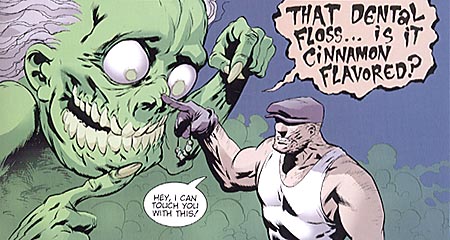
From Volume 1. Copyright Eric Powell.

with this:
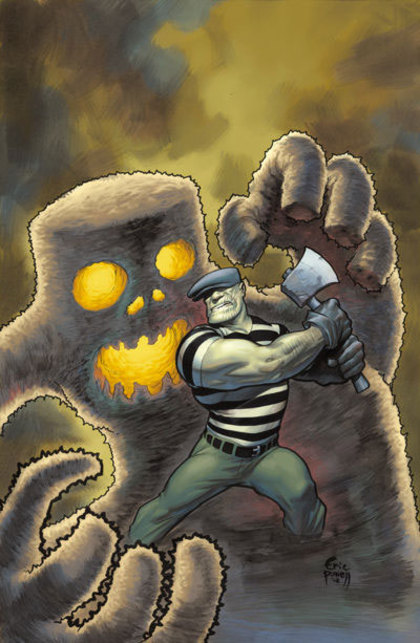
Issue 29 cover. Copyright Eric Powell.

Better, right? The second image is one used for a cover, but that’s what the comics themselves look like now. Powell has stated recently that he wished The Goon could’ve been a black and white series, but felt it wasn’t commercially plausible.  After seeing the beautiful coloring done by Dave Stewart, I’m grateful he decided to ditch the black and white.

I’ll just say it: if you’re an avid comics reader and you’re not reading The Goon, you’re doing something wrong. If you’re new to comics though, it’s a great place to start. I think the series really speaks for itself, so I scanned in a page as an example (sorry if the scan quality isn’t great, it’s the best I could do without breaking the book’s spine). So here you go, and if this doesn’t convince you to read The Goon then frankly I don’t know what will.

Happy reading,

-Nate

Copyright Eric Powell.
Webcomic Wednesday – Axe Cop

5 Oct

"I'll chop your head off!"

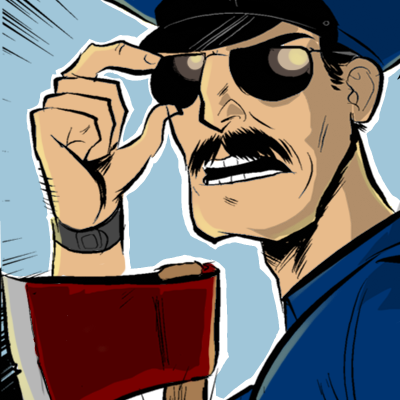
Remember when you were a kid, when your imagination wasn’t fettered by things like “logic” or “coherent thought?” When in the throes of play, toys didn’t even need to represent what their creators intended; a truck could be a rocket truck, a Barbie could be an evil witch, a Batman action figure could be a guy named Jeff who can fly and also shoot lasers out of his mouth. Now try to picture that same sort of creativity embodied in a comic: characters can become new characters at any time, the laws of physics are wholly ignored, and the main character is a police officer who uses an axe as a weapon. Meet Axe Cop.

If you use the Internet, there’s a good chance you’ve heard of Axe Cop. Basically, Ethan Nicolle, a twenty-nine year-old comic artist, illustrates his six year-old brother Malachai’s ideas for a comic, and the result is completely ridiculous and hysterical. And I’m not the only one who thinks so; according to the site’s “About” page, Axe Cop had 750,000 unique visits within a month of its debut.

There isn’t too much to say about the story, since it’s about as random as you (or a six year-old) could possibly imagine. Basically, it’s about a cop with an axe and the ridiculous sidekicks he meets and situations they find themselves in. Within the first five pages, we’re introduced to Axe Cop, Flute Cop, Dinosaur Soldier, Uni-Baby, Avocado Soldier, Telescope-Gun Cop, Ralph Wrinkles the dog, and Pretzel Head. Are you still reading this? You haven’t clicked the link yet? Maybe you missed it. Here it is again. The structure for most of the stories follows the pattern of “This happened, and then this happened, and then this happened, etc.” but it absolutely works. And hey, it’s a kid, so cut him some slack.

Not only is the story awesome, but it looks great too. Ethan’s art perfectly complements Malachai’s story, walking a fine line between cartoony and badass, acknowledging the absurdity of the comic while recognizing that none of it is meant ironically; Malachai has these ideas because he thinks they’re cool, so the art has to be cool too. Character designs are always great, facial expressions are always hilarious, and there are always plenty of action lines. While the ideas come from Malachai, Ethan also paraphrases and does most of the actual writing for the comic (he goes into more detail about the process on the site, and there’s a video of an episode being made here), and he does a great job of crafting his brother’s ideas into a tangible product, without inserting much of his own influence.

The beauty of Axe Cop is that it couldn’t have been made by anyone other than a kid. If a twenty-something was the one writing it, we’d all either shrug it off as juvenile, or just say that he was trying too hard. And he probably would be trying too hard; I think I have a pretty active imagination, but I’d have a hard time coming up with some of this stuff, or resisting the urge to make the story somewhat coherent. The sheer randomness of Axe Cop runs completely contrary to the way (most) adults think, and to what is conventionally thought to be good storytelling.

Axe Cop lets us remember what it was like to be a child not through contrived nostalgia, but through the actual thought process and unbridled creativity of a child. Does that make it some brilliant work commenting on the nature of childhood and the gradual suppression of creativity? Of course not, it’s a kid telling a story about a cop with an axe. But it’s sure fun to read.

Happy reading,

-Nate

Misc. Monday – CBLDF

3 Oct

Today I thought I’d write a little about the CBLDF, or Comic Book Legal Defense Fund. As the group’s website says, “Comic Book Legal Defense Fund is a non-profit organization dedicated to the protection of the First Amendment rights of the comics art form and its community of retailers, creators, publishers, librarians, and readers. The CBLDF provides legal referrals, representation, advice, assistance, and education in furtherance of these goals.” The website goes into more detail about the sort of work they do, so I won’t go much more into it here, but the CBLDF is really at the forefront of defending the comic medium from censorship.

The CBLDF has a ton of supporters in the industry, and a lot of artists have donated signed books and art to raise money for the group. Check out the online store for all the cool stuff you can get for supporting the fund. If you’ve got a bit more money to give, you can even meet comic superstars like Neil Gaiman and Jeff Smith.

So go check it out, and I’ll be back on Wednesday with this week’s webcomic.

Happy reading,

-Nate

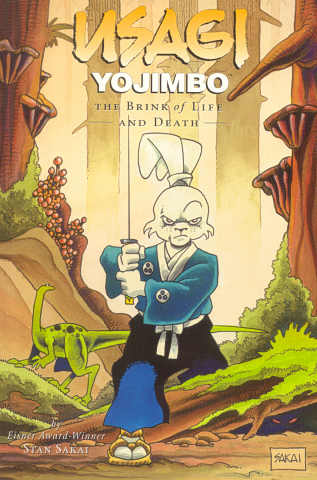
Favorites Friday – Usagi Yojimbo

30 Sep

Copyright Stan Sakai.

I think there’s a lot to be said for artists who are able to transcend cultural barriers, whether by creating new worlds entirely, or by presenting their own culture in such a way that it is easily accessible to outsiders, while at the same time preserving its unique aspects. I personally find the latter to be the more impressive, and those who are capable of this have a rare gift. Among those few is Stan Sakai, author of the superb Usagi Yojimbo.

Loosely based on the life of 17th century swordsman Miyamoto Musashi, the series is focused on the title character, a wandering swordsman who also happens to be an anthropomorphic rabbit. Like Musashi, he battles using two swords, and uses his fighting prowess to protect those who cannot protect themselves. Along the way he encounters a slew of equally colorful and well-developed characters, including Gen, a rhinoceros bounty hunter, and Jei, a demonic fox who claims to be a representative of the gods. The choice of animal for each character isn’t random, and it’s fun to think about what each character’s form says about their personality.

While Sakai admits that he does take a lot of liberties with the historical references in the story, the amount of research he uses for the series is frankly staggering, and the back of each book is filled with pages of endnotes and references to his sources. You obviously wouldn’t use Usagi for an academic paper, but it’s still a great way to get a taste of Japanese history presented in a really unique and well-presented way. In addition to historical events and characters, many of the stories also feature Japanese legends and folklore, and these are blended with the story just as deftly into one cohesive whole.

Perhaps most impressive about Usagi is the way in which it reads like both a Japanese comic and an American one, and at the same time neither. The art clearly has a strong Japanese influence, and yet an American influence is just as present. The same goes for the storytelling: the story and tone have both Japanese and American sensibilities that, together, give the series a tone that is at times humorous, contemplative, sorrowful, and celebratory.

There are currently 25 volumes of Usagi Yojimbo, and thankfully the series is written in a way that lets a reader pick up any volume and have a good sense of what’s going on in the story. That’s not to say there’s no continuity between volumes, but the references to earlier volumes don’t detract from the experience if you haven’t read the volumes referenced. This is also handy since a lot of libraries tend to carry Usagi, but in my experience their collections are pretty spotty and will just have random volumes. But they’re out there, so find them and read them for free. If you’re even slightly interested in samurai and Japanese history, this is a must-read. If you liked the “Redwall” books as a kid, this is a must-read. If you’re looking for a series that has it all, action, drama, humor, history, great art and characters, this is a must-read.

Happy reading,

-Nate

Webcomic Wednesday – Cucumber Quest

28 Sep

Copyright Gigi Digi

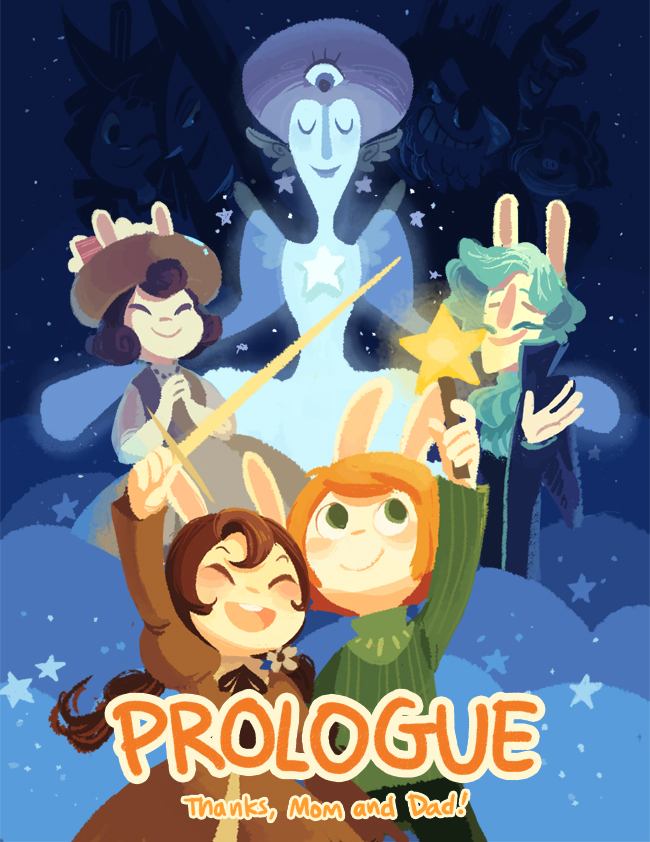
I was a bit hesitant to feature another fantasy comic so soon after Rice Boy, but this one is different enough, and way too much fun not to post. It’s called Cucumber Quest, and it’s a cute, goofy adventure story with some really interesting art and a great sense of humor. Or, as its creator Gigi Digi describes it,”a comic about bunny kids going on adventures and having fun.”

Right off the bat, we’re introduced to the main characters, Cucumber and his sister Almond (all the characters are named after, and somewhat resemble, food), as they find out their kingdom is in danger and only Cucumber can save it for some reason. Problem is, Cucumber is just a 9 year-old kid who was getting ready to leave for wizard school, and is probably the least-qualified person around to be a world-saving knight.

Since the comic was only started a few months ago, it isn’t very far along yet (96 pages at time of writing), but in that short space a lot of great characters and locations have been introduced. One of the great aspects of the comic is how it pokes fun at popular fantasy tropes that will be familiar to fans of the genre. Why doesn’t the all-knowing oracle just save the world herself? Why does an untrained kid have to be the one to save the world? This sort of questioning of the genre adds a lot of humor to the comic, but also shows that Gigi has put a lot of thought into the comic, and I’d bet my hat she has some big plans for the story. Also, be sure to read the hilarious captions she puts at the bottom of each strip; her humor really shines through the dry one-liners and they’re essentially a part of the comic themselves.

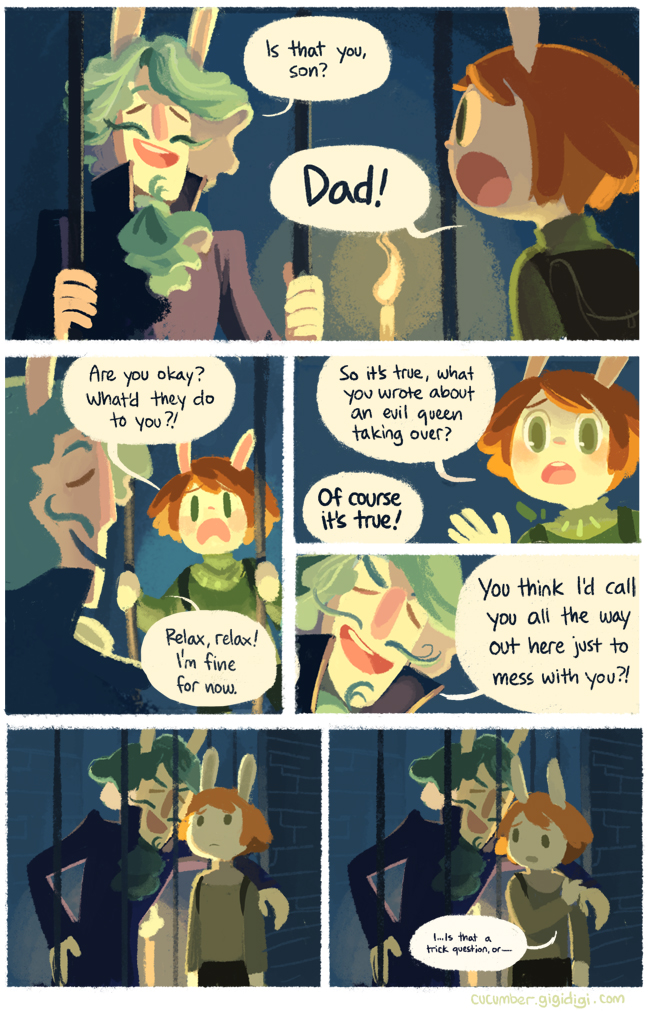
Cucumber Quest‘s art style is really distinctive and works great with the imaginative fantasy setting. The drawings are all done in bold colors without outlines, which really gives the comic a softer, youthful feel. Plus, her color choices are…heck, I’ll just show you.

Cucumber and his hilarious father, Cabbage. Copyright Gigi Digi

For a scene with some back story on the legend of the great hero, she even uses paper cutouts to give the out-of-story events a different look (it looks great, of course). Whatever tools she uses to draw these, it’s impressive that she’s able to create pages this lush two times a week.

So what are you waiting for? Great art, great laughs, and a setting that’s just plain fun. Go read it.

Happy reading,

-Nate

Misc Monday – American Splendor (the movie)

26 Sep

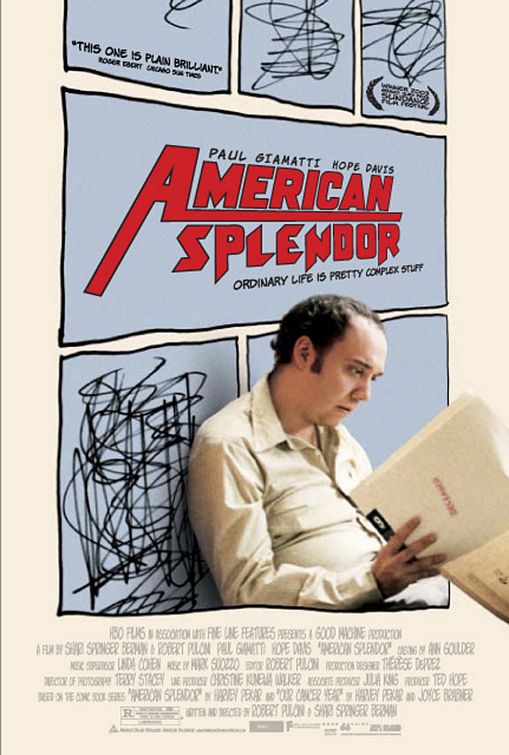
With the overabundance of movies based on comic books, it’s refreshing to see one that’s actually well-done; it’s almost unheard of for the main character to be a balding, slightly overweight, gloomy file clerk. And yet for some reason, it really works for American Splendor.

The movie follows the life of Harvey Pekar, the aforementioned file clerk who ends up becoming one of the leading figures in the alternative comics movement. We see his friendship with Robert Crumb, his decision to start making comics about his average and somewhat depressing life, and his eventual prominence, as well as the various ups and downs of his average and somewhat depressing life.

Since American Splendor, the movie, is based on “American Splendor,” the comic series, which itself is an autobiographical work, it offered some interesting possibilities to the filmmakers, which they absolutely seized. The comic’s creator and main character, the late Harvey Pekar, is portrayed splendidly by Paul Giamatti, but the film is narrated by the real Pekar (who often makes references to the fact that this is a movie), and the movie is also interspersed with footage of Pekar himself, as well as some of the other real people depicted in the comic and the movie. There are also portions shown as scenes from the comics, which gives an interesting insight into his creative process.

While I’m not sure I’d want to read too much of the comics themselves (Pekar had a pretty bleak view of life), the movie is nonetheless excellent, and offers an intriguing look into the life of a pioneer of American comics. For someone interested in alternative comics (or a fan of Paul Giamatti), it’s essential viewing.

Happy [watching],

-Nate

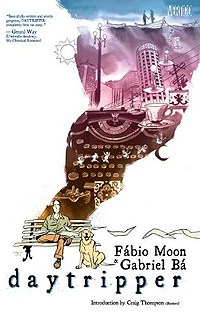
Favorites Friday – Daytripper

23 Sep

Copyright Moon and Ba

If your life flashed before your eyes, what would you see? Your first friend? Your first kiss? The birth of a child? The death of a loved one? While the experience would be different for everyone, chances are there would be some milestone moments in your life that would stand out, both positive and negative. Fabio Moon and Gabriel Ba’s Daytripper gives us a life-flash of sorts, and along the way reminds us just how beautiful and precious life is, and how easily it can end at any moment.

The book’s main character, Bras de Olivia Domingos, works as an obituary writer, trying to sum up peoples’ entire lives into a few lines every day. The job is understandably draining, and he can’t help wondering what his life would be like if he could ever finish that novel. The fact that his father is a world-famous novelist doesn’t help matters. The icing on the cake is when, stopping in at a bar for a quick drink before a gala his father is holding, he gets shot in the face. On page 32. Wait, what?

No, this isn’t the world’s shortest graphic novel, and it also isn’t some sort of afterlife story. There’s still plenty of story after this, and I think I’ve told you enough about it already. All I’ll say is that the book isn’t Bras’ life literally flashing before his eyes, as you’ll see if you read it. By the end of the book you really feel like you’ve just experienced the entirety of a person’s life, and it’s pretty astounding. As Craig Thompson writes in the introduction, “Daytripper is an honest meditation on mortality,” and that couldn’t be more true. In spite of the prominence of death in the story, the book succeeds in never feeling morbid or depressing

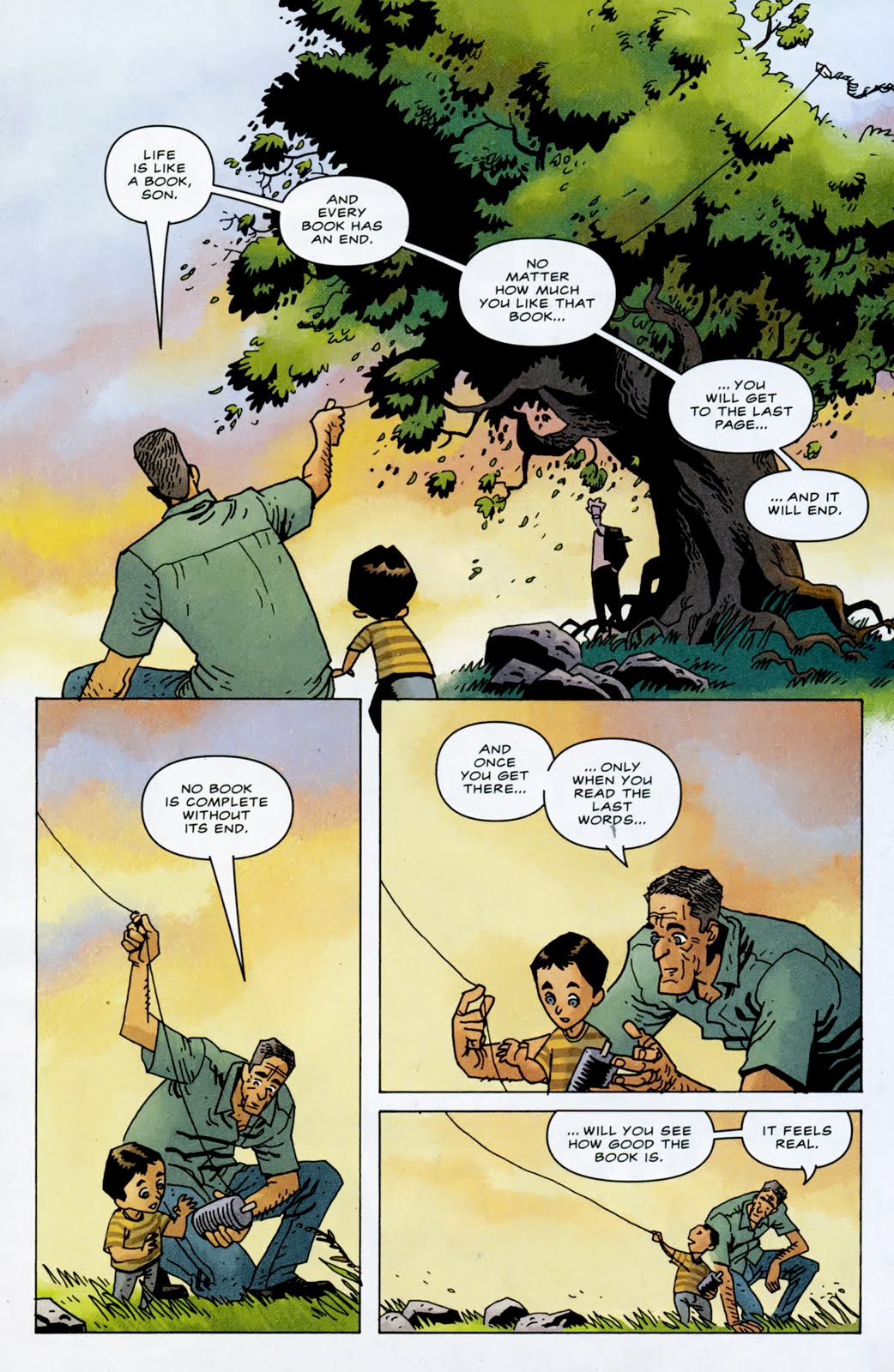
Moon’s writing here is really top-notch, and the people in Bras’ life feel like just that: people. They all have their own hopes and fears, strengths and insecurities, and are so well-written as to feel familiar. Moon takes us through the ups and downs of Bras’ extraordinary, yet perfectly normal, life. There’s some powerful stuff in here, especially in regards to Bras’ love life and his relationship with his father; all I have to do is just look at one of the last pages to get choked up again.

Ba’s art is outstanding as well, and works in perfect tandem with the writing to really bring the story to life (no wonder; the two are twin brothers). The art is detailed and realistic, but also has a fluid, dreamlike quality that reflects the storytelling. The colors are excellent as well, bold, beautiful watercolors that echo the tone of the story and highlight the colorful Brazilian culture.

In our day-to-day lives, it’s so easy to get caught up in the most insignificant things, or to not realize the significance in the little quiet moments where life’s beauty is at its fullest. Every day is a chance for happiness, and Moon and Ba remind us of all this in their beautiful book. Do yourself a favor and treat yourself to Daytripper; it just might change your life (or get you to change it).

Happy reading,

-Nate

A great example of the gorgeous writing and art in Daytripper. Copyright Moon and Ba

Webcomic Wednesday – Gunshow

21 Sep

Since there seemed to be a pretty big reaction last week to PBF, I figured I’d feature a (somewhat) similar comic this week: KC Green’s Gunshow.

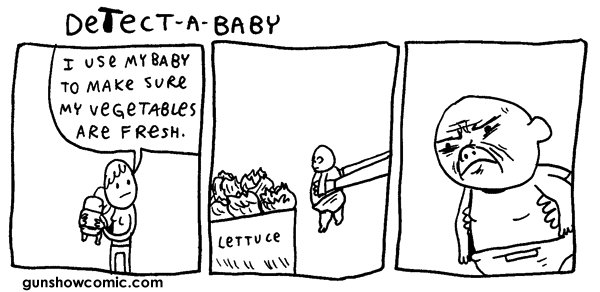
Gunshow’s humor would probably be described by many people as “immature.” A lot of the jokes are pretty random, and many aren’t even that clever, but for some reason they’re absolutely hilarious. Often the humor comes from the art, like this:

That is a stern baby. Copyright KC Green

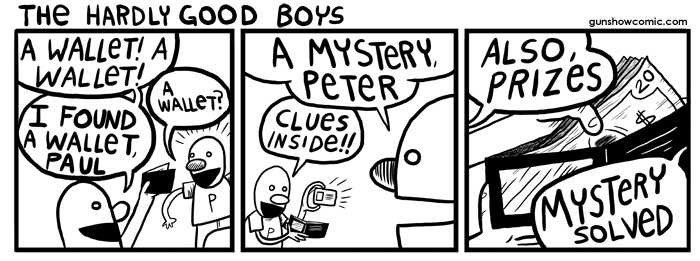
This is going to end up being a really short post, since the comics pretty much speak for themselves, and there’s no matters of plot to go into. So here’s another one:

Copyright KC Green

As you can tell, the art is pretty simplistic, but he can definitely draw effectively when he wants to. So what else can I say? If you like Beavis and Butthead or just random, crude humor, and you’re not too picky about art, Gunshow is absolutely worth your time. Have fun!

Happy reading,

-Nate

Misc Monday – Eisner’s “Comics and Sequential Art”

19 Sep

Many apologies for the lack of a post on Friday, folks; I’d been preparing for a big interview I had on Saturday (I think it went well!) so I just didn’t have time for a quality post. So if you’ve forgiven me for my lapse in posting and are reading this, I thank you.

Right now I’m reading Will Eisner’s Comics and Sequential Art, one of the first (the first?) books specifically about comics as an art form. As Eisner writes in the book’s intro, while his contemporaries were just as passionate about comics as he was, no one seemed to give much thought about the mechanics of comics, and certainly didn’t bother writing about them. So eventually Eisner started giving some thought to what makes comics tick, and what creators could do to move the medium forward. He started teaching a course on sequential art at New York’s School of Visual Arts, and collected his lectures into this book.

Eisner covers a lot of ground, with topics ranging from framing, time, expressive anatomy, and others. Along the way he gives lots of examples of what it is he’s talking about; most of the examples are from his own work (it’s what he knows best, after all), but this most recent edition also includes examples from more contemporary artists. His writing is very straightforward, and the book feels more conversational than academic, which keeps it from getting tiresome, even if he labors over a point a bit too long.

To be honest, the book could be organized a lot better; it seems like he repeats himself a fair amount, and some sections could’ve been structured better. Two of the main books that drew inspiration from this, Scott McCloud’s Understanding Comics and Making Comics, I have to admit, are better organized and go a bit further with the points than Eisner does. That said, Comics and Sequential Art still has a wealth of information and would be worth the time of both someone interested in making comics and to someone who’s just curious about how comics do what they do.

Happy reading,

-Nate

Webcomic Wednesday – Perry Bible Fellowship

14 Sep

While I love a great story, I still think of the Perry Bible Fellowship as one of my favorite webcomics. PBF has a strip format and pretty much every strip is pure gold. The humor is usually somewhat dark and sometimes will feature some taboo subjects, but it never relies on crudeness or shock for laughs. The comic’s creator, Nicholas Gurewitch, occasionally works with others on the comic, so the art style tends to vary pretty widely from strip to strip.

For the past several years there hadn’t been any new updates, but just a few weeks ago fans were treated to a new comic. Whether it signals a return to somewhat-regular updates remains to be seen, but for newcomers this is as good a time as any to start reading. Just hitting the “Random” button works fine, but you might want to just read from the first comic to experience the whole collection.

Happy reading,

-Nate