Archive | Uncategorized RSS feed for this section

Misc. Monday – SPX wrap-up

12 Sep

Well, SPX was pretty outstanding. The main exhibition floor was in a large ballroom in a hotel convention center, so it had a real ritzy feel to it, but given the number of exhibitors and attendees (shouldn’t it be “attenders?” The convention is the “attendee”) it got pretty packed. That said, everybody there made the best of the limited space and nobody I encountered was rude. The big names at the convention (Craig Thompson, Kate Beaton, and others) had designated signing times, which is understandable, but we ended up missing the Thompson signing because we a) didn’t know there were designated times until we got there, and b) they had already capped the line by the time we got in. Se la vie.

Aside from the huge lines for the big names, there were almost no lines to meet the artists and writers, giving the twofold benefit of not having to wait and not feeling rushed while talking to the exhibitors. All the exhibitors I spoke with were really kind and gracious, no prima donnas like at bigger cons. Some of the artists I met were Evan Dahm (Rice Boy), Aaron Diaz (Dresden Codak), KC Green (Gunshow), Carla Speed McNeil (Finder), and Nate Powell. Plus there were a ton of great, lesser-known artists showing their work at the Expo, and it was great to walk around and take it all in, plus find some cool stuff I wouldn’t have otherwise.

Based on when we got to the show, when we had to leave, and the day’s panels, we ended up only going to one, a Q&A with the outstanding Craig Thompson. The questions were mainly about his upcoming book Habibi, which was fine because the pages he previewed for us looked astounding, and the discussion was interesting as well. I’m planning on picking up a copy asap, and you can expect a review of it here soon.

I spent more money at the show than I intended to, and I’m still reading through all of it, but I wanted to give a few highlights out of what I picked up, in the hopes that you’ll check it out and support these great artists. So without further ado:

  • Midnite Surprise, by KC Green- An absolutely hilarious collection of random comics and drawings from his blog of the same name. If you like Gunshow, or if you’ve never read Gunshow but like random, sometimes crude humor, definitely check out the blog. This one really surprised me.
  • Pang the Wandering Shaolin Monk, by Ben Costa- This is a great series about (you guessed it) a traveling Shaolin monk in 16th century China. Costa has really done his research, and the book is filled with footnotes explaining various plot points and historical references. His drawings have a really distinctive look as well, a somewhat-cartoony style that brings to mind Asian ink paintings. Add to all this the fact that he self-publishes the book with a grant from the prestigious Xeric Foundation (one of the last, now that the foundation is ending its grants). The whole comic is online to read for free, but the first printed volume is really well-done, and if you like the comic I’d recommend picking up a copy.
  • The Blot, by Tom Neely– I discovered Tom Neely by just browsing through the SPX guest list in the weeks before the show, and was really blown away by what was on his website. The Blot is a mostly wordless, semi-abstract tale that blends an innocent-looking visual style with some dark psychological themes, and is very, very impressive. I really wanted to pick up Neely’s new book The Wolf as well, which is even more abstract (and disturbing, by the looks of it), but I just didn’t have the cash. Based on The Blot though, I’ll be ordering a copy once my wallet has had a chance to recover.

I wish I could tell you about everything I saw there, but I just don’t have the time or space, and is a great reason why you should go next year! The atmosphere at the show is one of support and a shared love of comics, and seeing so many people who have self-published their work, in most cases for nothing more than a passion for comics, is really inspiring. The Con continues to grow, so I’m sure next year will be even better, and it’ll be one you won’t want to miss.

Happy reading,

-Nate
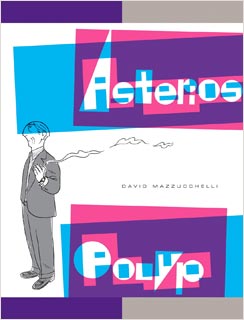
Favorites Friday – Asterios Polyp

9 Sep

About six months ago, I wrote a review of Asterios Polyp for Elizabethtown College Comic Club’s magazine, Suh-Weet Comics. Since the planned issue never got published, however, the review wasn’t used and I’ve sat on it until now. I thought maybe I could just swipe most of what I’d written and save myself some trouble, but before looking over the review again I decided to re-read the book itself. Reading Asterios Polyp a second time was an almost entirely different experience than the first, and I realized my initial review was now pretty useless. Finding a piece of art of such depth is somewhat rare, and finding such a comic is, unfortunately, more so.

A brief synopsis: Asterios Polyp follows its title character, a retired professor and “paper architect” (none of his designs have ever been built) who has just turned 50, and whose apartment has just burned to the ground. He leaves his home and doesn’t look back, and along the way we learn about this man’s past and simultaneously see how he’s changing in the present. We also see his gradual transformation from a self-absorbed, pompous intellectual into…well, I won’t spoil anything. He does meet a variety of people who challenge his ways of thinking, and cause him to reflect on who he is and how his life came to this point. You may be questioning how you’ll be able to relate to a snooty, middle-aged jerk, but it’s not as hard as it sounds.

When talking about Asterios, the first thing to comment on will always be its formal qualities. So much of the book screams out “This is a comic!” but it uses this self-awareness to fully exploit the advantages of the comic medium. Most apparent is Mazzuchelli’s choice to work mainly using cyan, magenta, and yellow (the three printing colors), which instantly gives the book a unique visual style. Going further, certain colors are assigned to certain philosophies, and the way a character is drawn is a reflection of that character’s personal worldview. These and other similar elements allow Mazzuchelli to show us some really outstanding things about the way the characters interact that simply wouldn’t have been possible (or at least as elegantly accomplished) in any other medium.

One of the aspects of the book I focused on in my first review is how this book can mean so many things to different people. Everything about this book, from individual words to seemingly insignificant visual details, is loaded with purpose and meaning, and with its abundance of themes (including love & relationships, art, academia, duality, existentialism, Greek mythology, plus plenty more and likely plenty I didn’t pick up on), it’s only natural that a reader will focus on certain themes in particular, depending on that reader’s experiences and inclinations; like I said, reading the book again after only nine months was a very different experience for me. I imagine that all of you would read the book in a different way than me, and then again in a slightly different way in the future.

Another way Mazzuchelli displays his mastery is in the way that he shifts the reader’s perception of the story as it progresses. Lines and images are repeated in ways that illuminate more fully the earlier appearances, often with heart-wrenching results. And just about everything introduced is referenced again at least once, which gives the book a sense of neatness and coming full circle. It’s also important that I say that aside from all the book’s formal qualities and techniques, at its core there is a very emotionally engaging story about love (not quite a love story) that I’m sure most people can identify with in some way.

Asterios Polyp is one of my favorite books, hands down, and is one that you must read. Whether that means shelling out the money yourself or borrowing it from someone, just make it happen. This is such a beautiful work of art, and one that I feel can be appreciated by anyone, fan of comics or not. You might read it and not like it, but it’s still undoubtedly one of the most important comics out there, and for that reason alone is worth your time. Please check it out, you’ll be happy you did.

Happy reading,

-Nate

Webcomic Wednesday – Dresden Codak

7 Sep

Let’s face it: low-brow sells. Whether it’s trashy reality TV, explosion-laden movies, or cheap, cliched novels, there’s an ever-growing market for entertainment that requires little to no intellectual engagement. It’s all the more impressive, then, when an artist comes along who demands more from his audience.

Meet Aaron Diaz and his comic, Dresden Codak. Focusing mainly on Kimiko Ross, a 22-year old scientist and robotics expert who gets herself into situations of varying danger in the name of science, Dresden sets the bar a little higher right from the start by having an introverted intellectual as its main character. There are two main storylines that follow Kim, as well as several one-shot comics, plus others that have an assortment of characters and topics. A unifying thread for all of the comics is a high level of braininess, and the comics have almost constant references to various scientific and philosophical ideas and terms. An understanding of these ideas is needed to fully appreciate the comics, so don’t feel ashamed about doing some looking on Wikipedia (I had to look up quite a bit).

With all these weighty ideas being tossed around, what keeps Dresden Codak from feeling forced or pretentious is that one gets the sense that Diaz, like his characters, is genuinely passionate about the topics he covers, and he has no desire to “dumb things down” for the sake of wider appeal. That said, if the very thought of science repels you, you simply won’t like Dresden Codak. But even if that’s the case, it’s still worth checking out if only for the pretty pictures. If this is something that interests you, I think you’ll absolutely love it.

One of the things that really makes Dresden stand out to me is the way in which Diaz fully takes advantage of the webcomic medium. More often with the stand-alone comics, Diaz will choose to put the entire comic on one page, making it as long as it needs to be, which is something that can really only be done on the unlimited canvas of a website. While it makes collecting these into a book difficult (or impossible), it really shows off Diaz’s ability to lay out a page, something he does beautifully, forgoing tradition panel borders in favor of a more organic layout.

Another great aspect of Dresden is Diaz’s ability to vary his art style depending on the comic, and the wide array of styles he showcases on the site is very impressive. His art has also improved in leaps and bounds since he first started the site, so I would recommend starting with some of the more recent comics before going back to older ones. His most recent comics are absolutely gorgeous, and though it takes him a while to update, one can certainly understand why, and the wait for art of this quality is absolutely worth it.

A quick note on reading order: I would recommend starting with a few of the shorter comics, like “Lantern Season” (my favorite), “The Sleepwalkers,” and “Traversing the Luminiferous Aether” to get a sense of Diaz’s art and humor. If you like those, then go on to the main storylines (“Dark Science” is superb) and then revisit the rest of the short comics after those. As always, let me know what you think of it if you decide to check it out. Also, I’ll be meeting Diaz at SPX on Saturday, and I’ll put up pics of any cool merch I snag.

Happy reading,

-Nate

Misc Monday – SPX

5 Sep

In addition to Webcomic Wednesdays and Favorites Fridays, I plan on using Mondays as a sort of catch-all for whatever doesn’t fit on the other days: whether it’s news, a review, a more in-depth look at a specific book, or whatever. And feel free to give suggestions/requests regarding things for me to write about.

Today I figured I’d talk a little about the Small Press Expo, or SPX. Taking place this weekend, Sept. 10-11, in Bethesda, MD, this ever-growing convention brings together independent publishers, writers, and artists, and is unique in its policy of not selling exhibition tables to retailers. The enormous guest list boasts a lot of big names in alternative comics and webcomics, including Craig Thompson (Blankets), Chris Hastings (Dr. McNinja), Kate Beaton (Hark! a Vagrant), KC Green (Gunshow Comic), and Rice Boy’s own Evan Dahm. There will also be various panels by artists and publishers, and an awards ceremony honoring the best alternative comics of the year. If you’ve never been to a comic convention and you’re in the area, I’d recommend going, since it’s more of an intimate atmosphere than the big cons, and you get to interact more with the artists. Plus a lot of these artists self-publish, so by buying their stuff your money isn’t going through a middle-man. And you get to discover a lot of great work that would be tough to come across otherwise.

I’m absolutely thrilled to be going, and I’ll post about my experience in Monday’s post. Let me know if you’re going (I’ll be there Saturday), but if you’re not then consider me your representative there. Self-published books tend to be slightly cheaper than books from the big companies, but I’m still preparing for my wallet to take a beating, and I’ll be sure to come back with plenty of review-worthy material.

Wednesday will be another webcomic review, so keep an eye out for it! Also, feedback is always welcome, and if you check out any of the series I recommend I’d love to hear what you think of them.

-Nate

Favorites Friday – The Sandman

2 Sep

Again, an explanation probably isn’t necessary, but I’ll use Fridays to write about my all-time favorite books and series, again trying to find a balance between classics and some lesser-known titles. Ok, on with the review.

In ancient times, mythology was used to provide explanations for natural events, as well as to give the people guidance on how to lead their lives. Divine beings were often given human characteristics, including the very same flaws that characterize humans. In The Sandman, Neil Gaiman has accomplished the impressive feat of creating his own mythology, a rich and intriguing world that interacts with our own, and teaches us a few things about ourselves.

The Sandman is centered around Dream (not the god of dream, he is “Dream”…you’ll see) and his “siblings,” Destiny, Death, Desire, Despair, Destruction, and Delirium, who form a group of beings called the Endless. The series begins with Dream imprisoned by a cult attempting to gain his power. I won’t say much more about the plot, but it mostly concerns Dream’s interactions with mortals, whether in the waking world or the realm of dreams. In the process Gaiman weaves in boatloads of mythology and folk tales and manages to blend a huge array of traditions from around the world into a cohesive whole. What really makes The Sandman special is that Gaiman doesn’t restrict events to the mythical worlds he creates, he has the characters interact with our world, regular people in places like London and New York. These forays into the mortal world have a lot to show us about the anxieties of modern life, and the effect that dreams can still have on us, even in this age of technology.

One of the most astounding aspects of Sandman is the way in which Gaiman sets up events and characters very early on that become significant later in the story. Two books in the ten are comprised of shorter stories, often only marginally related to Dream, and yet nearly all of them are woven back into the main thread of the story later on. Maybe revealing that takes away from the surprise somewhat, but it’s certainly worth mentioning in a review, and I doubt that me telling you about it will tarnish the experience very much. It really is virtuosic in its execution, and I’m sure you’ll find yourself marveling at Gaiman’s skill as well.

A note: nearly every issue of Sandman is drawn by a different artist, which to me is a bit of a double-edged sword. On the one hand you get a very wide variety of styles and visual interpretations of Gaiman’s writing, but on the other, if you find that you’re really fond of one particular artist’s style, you may be disappointed by not seeing that artist’s work in the series again. But the changing styles do have some relevance to the story and the shifting nature of the Endless, so it’s forgivable.

As the story unfolds, Dream is forced to make some very difficult decisions, which he makes to the best of his ability and judgment, and is then forced to deal with the consequences. Everyone is subject to these situations, Gaiman tells us, even an Endless, and the best thing one can do is to do what they believe to be right. If we can recognize that everyone else goes through tough times, we can take comfort in knowing that we’re not alone, and maybe do something to ease the burden of others.

Pick this one up, you won’t be disappointed.

Happy reading,

-Nate

P.S. You can probably find this one at a library, and if not, at least you could get it on loan.

Webcomic Wednesday – Rice Boy

31 Aug

As you can probably tell from the title, every Wednesday I’ll review a different webcomic, so you can discover new comics while still going easy on your wallet. The first webcomic(s) I’ll feature here are the same ones I always tell friends about first- Evan Dahm’s Overside comics, most notably Rice Boy. http://www.rice-boy.com is actually home to three separate comics, two of which are each close to 1,000 pages. All three comics take place at various points in time in the world of Overside, and are all fantasy series with varying tones and styles.

Rice Boy, the earliest comic on the site, absolutely oozes charm and is probably the most accessible of the three. Because of this, as well as reasons of continuity, newcomers should definitely start with RB. The story follows the journey of the titular character, a small, timid, limbless…being (person? creature?) named Rice Boy as he leaves the comfort of his home and finds himself caught in the middle of ancient prophecies and a massive war. On his way he meets a plethora of unusual characters who are enhanced by the series’ distinct, quirky visual style (I’m always reminded of Dr. Seuss).

While reading RB, it’s very apparent that Rice Boy is Dahm’s first long-form narrative, and yet in every aspect of the comic this freshness works to its advantage. The drawings aren’t as sharp as Dahm’s more recent work; the storytelling, at times, seems to be more of a string of strange places and characters than a carefully constructed plot (not to say there isn’t one…), and the various races and locations of Overside seem to only be given superficial attention. But when you consider that the main character is a naive youngster who has never ventured must farther than his front door, these shortcomings take on a new dimension. The almost cartoony visual style reflects the way that Rice Boy sees the world, the story structure reflects the way that Rice Boy is quickly whisked from place to place before he can catch his breath, and the the fact that we’re given little background on the world lets us experience the world for the first time along with Rice Boy. As I said, it sometimes feels like Dahm was flying by the seat of his pants as he wrote this, but it also feels like he was having an immense amount of fun, which gets passed on to the reader.

Dahm’s next work, Order of Tales, is quite different from RB in several ways. By this point Dahm had two years of experience under his belt, and this shows in both his art and the story. Though some of the spontaneity of RB is lost because of this, on the whole it feels like a much stronger and more focused work. OoT focuses on Koark, the last in the line of the Order of Tales, an ancient organization dedicated to the documenting and preservation of stories. As he sets out to find a fabled story, “The Ascent of the Bone Ziggurat,” he soon discovers that there might be more to the story than he anticipated. Although OoT occurs before the events of Rice Boy, there are some surprises that will only be meaningful to those who’ve read RB first.

In contrast to RB, OoT is drawn entirely in black and white, with a much sharper, more detailed line style. It might take a little getting used to after RB, but you get used to it pretty fast, and it really goes with the story’s relatively darker tone. The story is also structured much better than RB, and Koark is a much more active protagonist. Another key aspect of OoT is that this time around we’re given much more information about the world of Overside and its inhabitants, which is appropriate seeing as how Koark is essentially a traveling historian. The story is occasionally broken up by stories straight from Koark’s book of tales, which adds a really unique flavor to the series. Another excellent series, there isn’t much more to say.

The last of the big three is Vattu, which is currently running, and at the time of me writing is at about 170 pages. Vattu follows the life of a young member of a nomadic race called the Fluters. I won’t say too much more about the story since the comic is still in its early stages. What I will say though is that the color in Vattu is absolutely gorgeous, especially instances where light and shadows give surroundings an interesting tone. The story is also a bit different than the other two comics, as a lot of it is told with little dialogue, focusing instead on the characters’ actions and the landscape around them. The pace is much slower than, say, OoT, but it’s a deliberate pace, and recently  in the story it’s become apparent that Dahm has some big developments up his sleeve.

In addition to the three long series, Dahm also makes short stories that further expand upon the world of Overside. Despite their shorter length they’re all great, and they contain some of my favorite moments from his comics. The site also has a link to a fan-maintained wiki that documents all the information on Overside and the comics (just watch out for spoilers).

As you could probably guess by the obnoxious length of this post, I’m all about the Overside comics. I could easily write more, but I think I’ve already written more than enough. They’re all absolutely superb, and I highly, highly recommend you check them out. I’m flattered that you read this far before going to check them out, but go. Do it. I won’t be offended.

Happy reading,

-Nate

And so it begins…

30 Aug

Like a lot of people my age, I grew up watching the various superhero cartoons that were on in the early 90’s, like Batman, X-Men and Spiderman. My fascination with these heroes led to an early interest in comics, which has held true up to today. One thing I noticed over time, though, was that I hadn’t read very many comics featuring the characters I grew up on. After exploring a bit with some of their comics, I noticed that I liked the idea of these characters better than the comics themselves (with a few notable exceptions). Eventually I reached a point where the idea of reading about the same characters doing essentially the same things again and again just wasn’t appealing anymore. This was also around the same time that I started reading series that weren’t published by Marvel or DC, and which had fresh ideas, by writers and artists who took risks. I haven’t looked back.

Early on, the process of discovering new series to read was pretty much a dart toss, and I judged a lot of books by their covers. Since books put out by smaller publishers (let alone those self-published by artists) don’t get much publicity, it’s still somewhat difficult to find good new books to read. I decided that I wanted to help other people in a similar situation find some good reads, and maybe get some of the superhero faithful to try something different. So this blog will be dedicated to reviewing alternative/independent/underground/whatever comics; so we don’t get too caught up in definitions, it’ll basically be anything not a) published by Marvel or DC and b) anything focused on superheroes. I’ll try to feature a mix of classics and some lesser-known titles, so hopefully newcomers and connoisseurs alike will find something of interest here. Feel free to leave me a comment with any suggestions you might have, or what sort of stuff you’d like me to write about.

One last note on the blog’s content. For a lot of reasons, but mainly for the fact that there are way too many comics worth your time to waste space reviewing those that aren’t, you’ll only find positive reviews here. That, of course, does not mean that I like everything I read; you just won’t find those books here.

I’ll have the first review up tomorrow, and I plan to stick to a regular update schedule after that, probably a MWF schedule.

Thanks for reading!

-Nate