Tag Archives: fantasy

Webcomic Wednesday – Cucumber Quest

28 Sep

Copyright Gigi Digi

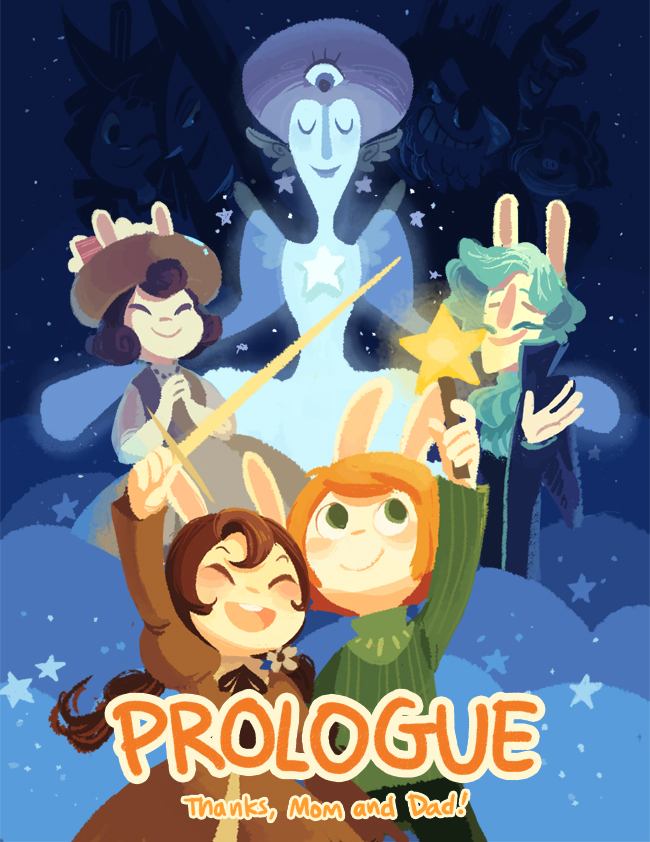
I was a bit hesitant to feature another fantasy comic so soon after Rice Boy, but this one is different enough, and way too much fun not to post. It’s called Cucumber Quest, and it’s a cute, goofy adventure story with some really interesting art and a great sense of humor. Or, as its creator Gigi Digi describes it,”a comic about bunny kids going on adventures and having fun.”

Right off the bat, we’re introduced to the main characters, Cucumber and his sister Almond (all the characters are named after, and somewhat resemble, food), as they find out their kingdom is in danger and only Cucumber can save it for some reason. Problem is, Cucumber is just a 9 year-old kid who was getting ready to leave for wizard school, and is probably the least-qualified person around to be a world-saving knight.

Since the comic was only started a few months ago, it isn’t very far along yet (96 pages at time of writing), but in that short space a lot of great characters and locations have been introduced. One of the great aspects of the comic is how it pokes fun at popular fantasy tropes that will be familiar to fans of the genre. Why doesn’t the all-knowing oracle just save the world herself? Why does an untrained kid have to be the one to save the world? This sort of questioning of the genre adds a lot of humor to the comic, but also shows that Gigi has put a lot of thought into the comic, and I’d bet my hat she has some big plans for the story. Also, be sure to read the hilarious captions she puts at the bottom of each strip; her humor really shines through the dry one-liners and they’re essentially a part of the comic themselves.

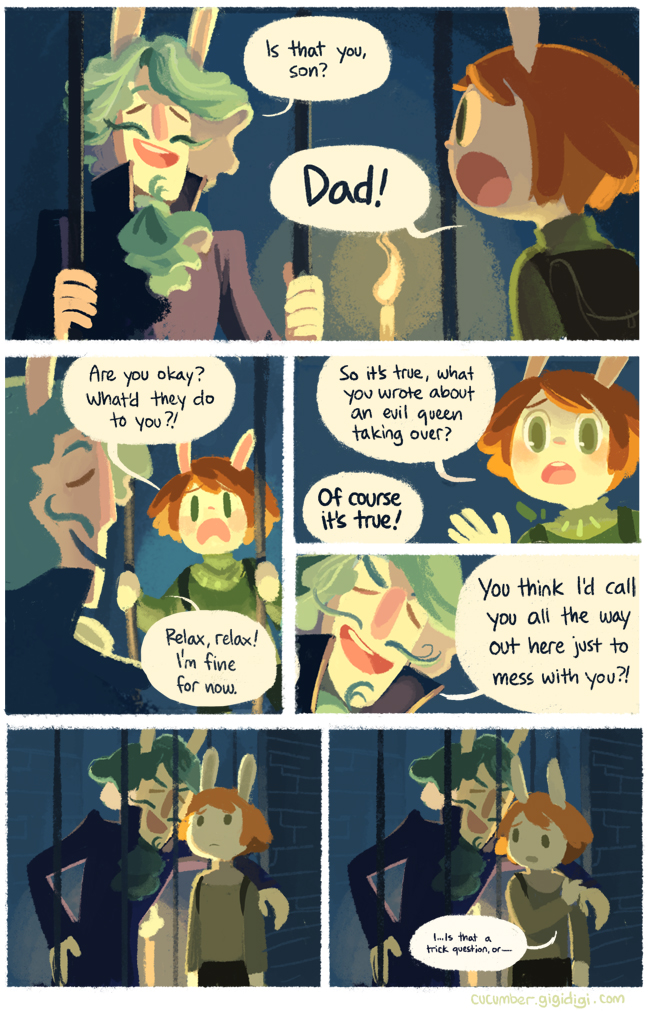
Cucumber Quest‘s art style is really distinctive and works great with the imaginative fantasy setting. The drawings are all done in bold colors without outlines, which really gives the comic a softer, youthful feel. Plus, her color choices are…heck, I’ll just show you.

Cucumber and his hilarious father, Cabbage. Copyright Gigi Digi

For a scene with some back story on the legend of the great hero, she even uses paper cutouts to give the out-of-story events a different look (it looks great, of course). Whatever tools she uses to draw these, it’s impressive that she’s able to create pages this lush two times a week.

So what are you waiting for? Great art, great laughs, and a setting that’s just plain fun. Go read it.

Happy reading,

-Nate

Favorites Friday – The Sandman

2 Sep

Again, an explanation probably isn’t necessary, but I’ll use Fridays to write about my all-time favorite books and series, again trying to find a balance between classics and some lesser-known titles. Ok, on with the review.

In ancient times, mythology was used to provide explanations for natural events, as well as to give the people guidance on how to lead their lives. Divine beings were often given human characteristics, including the very same flaws that characterize humans. In The Sandman, Neil Gaiman has accomplished the impressive feat of creating his own mythology, a rich and intriguing world that interacts with our own, and teaches us a few things about ourselves.

The Sandman is centered around Dream (not the god of dream, he is “Dream”…you’ll see) and his “siblings,” Destiny, Death, Desire, Despair, Destruction, and Delirium, who form a group of beings called the Endless. The series begins with Dream imprisoned by a cult attempting to gain his power. I won’t say much more about the plot, but it mostly concerns Dream’s interactions with mortals, whether in the waking world or the realm of dreams. In the process Gaiman weaves in boatloads of mythology and folk tales and manages to blend a huge array of traditions from around the world into a cohesive whole. What really makes The Sandman special is that Gaiman doesn’t restrict events to the mythical worlds he creates, he has the characters interact with our world, regular people in places like London and New York. These forays into the mortal world have a lot to show us about the anxieties of modern life, and the effect that dreams can still have on us, even in this age of technology.

One of the most astounding aspects of Sandman is the way in which Gaiman sets up events and characters very early on that become significant later in the story. Two books in the ten are comprised of shorter stories, often only marginally related to Dream, and yet nearly all of them are woven back into the main thread of the story later on. Maybe revealing that takes away from the surprise somewhat, but it’s certainly worth mentioning in a review, and I doubt that me telling you about it will tarnish the experience very much. It really is virtuosic in its execution, and I’m sure you’ll find yourself marveling at Gaiman’s skill as well.

A note: nearly every issue of Sandman is drawn by a different artist, which to me is a bit of a double-edged sword. On the one hand you get a very wide variety of styles and visual interpretations of Gaiman’s writing, but on the other, if you find that you’re really fond of one particular artist’s style, you may be disappointed by not seeing that artist’s work in the series again. But the changing styles do have some relevance to the story and the shifting nature of the Endless, so it’s forgivable.

As the story unfolds, Dream is forced to make some very difficult decisions, which he makes to the best of his ability and judgment, and is then forced to deal with the consequences. Everyone is subject to these situations, Gaiman tells us, even an Endless, and the best thing one can do is to do what they believe to be right. If we can recognize that everyone else goes through tough times, we can take comfort in knowing that we’re not alone, and maybe do something to ease the burden of others.

Pick this one up, you won’t be disappointed.

Happy reading,

-Nate

P.S. You can probably find this one at a library, and if not, at least you could get it on loan.

Webcomic Wednesday – Rice Boy

31 Aug

As you can probably tell from the title, every Wednesday I’ll review a different webcomic, so you can discover new comics while still going easy on your wallet. The first webcomic(s) I’ll feature here are the same ones I always tell friends about first- Evan Dahm’s Overside comics, most notably Rice Boy. http://www.rice-boy.com is actually home to three separate comics, two of which are each close to 1,000 pages. All three comics take place at various points in time in the world of Overside, and are all fantasy series with varying tones and styles.

Rice Boy, the earliest comic on the site, absolutely oozes charm and is probably the most accessible of the three. Because of this, as well as reasons of continuity, newcomers should definitely start with RB. The story follows the journey of the titular character, a small, timid, limbless…being (person? creature?) named Rice Boy as he leaves the comfort of his home and finds himself caught in the middle of ancient prophecies and a massive war. On his way he meets a plethora of unusual characters who are enhanced by the series’ distinct, quirky visual style (I’m always reminded of Dr. Seuss).

While reading RB, it’s very apparent that Rice Boy is Dahm’s first long-form narrative, and yet in every aspect of the comic this freshness works to its advantage. The drawings aren’t as sharp as Dahm’s more recent work; the storytelling, at times, seems to be more of a string of strange places and characters than a carefully constructed plot (not to say there isn’t one…), and the various races and locations of Overside seem to only be given superficial attention. But when you consider that the main character is a naive youngster who has never ventured must farther than his front door, these shortcomings take on a new dimension. The almost cartoony visual style reflects the way that Rice Boy sees the world, the story structure reflects the way that Rice Boy is quickly whisked from place to place before he can catch his breath, and the the fact that we’re given little background on the world lets us experience the world for the first time along with Rice Boy. As I said, it sometimes feels like Dahm was flying by the seat of his pants as he wrote this, but it also feels like he was having an immense amount of fun, which gets passed on to the reader.

Dahm’s next work, Order of Tales, is quite different from RB in several ways. By this point Dahm had two years of experience under his belt, and this shows in both his art and the story. Though some of the spontaneity of RB is lost because of this, on the whole it feels like a much stronger and more focused work. OoT focuses on Koark, the last in the line of the Order of Tales, an ancient organization dedicated to the documenting and preservation of stories. As he sets out to find a fabled story, “The Ascent of the Bone Ziggurat,” he soon discovers that there might be more to the story than he anticipated. Although OoT occurs before the events of Rice Boy, there are some surprises that will only be meaningful to those who’ve read RB first.

In contrast to RB, OoT is drawn entirely in black and white, with a much sharper, more detailed line style. It might take a little getting used to after RB, but you get used to it pretty fast, and it really goes with the story’s relatively darker tone. The story is also structured much better than RB, and Koark is a much more active protagonist. Another key aspect of OoT is that this time around we’re given much more information about the world of Overside and its inhabitants, which is appropriate seeing as how Koark is essentially a traveling historian. The story is occasionally broken up by stories straight from Koark’s book of tales, which adds a really unique flavor to the series. Another excellent series, there isn’t much more to say.

The last of the big three is Vattu, which is currently running, and at the time of me writing is at about 170 pages. Vattu follows the life of a young member of a nomadic race called the Fluters. I won’t say too much more about the story since the comic is still in its early stages. What I will say though is that the color in Vattu is absolutely gorgeous, especially instances where light and shadows give surroundings an interesting tone. The story is also a bit different than the other two comics, as a lot of it is told with little dialogue, focusing instead on the characters’ actions and the landscape around them. The pace is much slower than, say, OoT, but it’s a deliberate pace, and recently  in the story it’s become apparent that Dahm has some big developments up his sleeve.

In addition to the three long series, Dahm also makes short stories that further expand upon the world of Overside. Despite their shorter length they’re all great, and they contain some of my favorite moments from his comics. The site also has a link to a fan-maintained wiki that documents all the information on Overside and the comics (just watch out for spoilers).

As you could probably guess by the obnoxious length of this post, I’m all about the Overside comics. I could easily write more, but I think I’ve already written more than enough. They’re all absolutely superb, and I highly, highly recommend you check them out. I’m flattered that you read this far before going to check them out, but go. Do it. I won’t be offended.

Happy reading,

-Nate