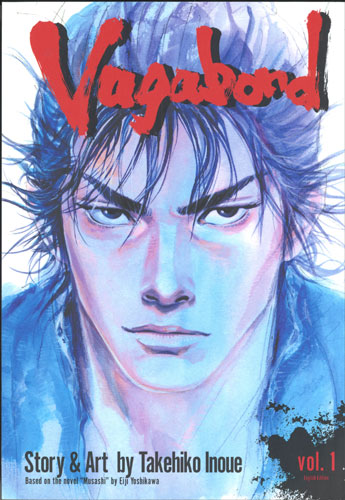
Copyright Inoue Takehiko
When you hear the word “manga,” what comes to mind? Wide-eyed characters shooting laser beams at each other? Giant robots battling in space? Creepy fetishistic nonsense? While those sorts of series are part of the manga spectrum, it seems that most Americans are under the impression that that’s all there is to manga, and as a result they overlook many of the gems to be found. Inoue Takehiko’s Vagabond is one of those gems. With its superb artwork, engaging storytelling, and subtle characterization, Vagabond is a raw, visceral, and emotional look at the life of Miyamoto Musashi, and is hands-down one of the best comic series I’ve come across.
One of the prominent figures in Japanese history, and one of the best-known overseas, Miyamoto Musashi was Japan’s most famous samurai and arguably one of the greatest warriors in the history of the human race. Musashi lived in the early 17th century, and spent the better part of his life traveling around Japan seeking out and challenging the strongest swordsmen to perfect his own skills. He is best known as the founder of the niten-ryu school, notable for its two-sword techniques, and as the author of the popular Book of Five Rings, a treatise on philosophy and strategy. Miyamoto has been the subject of dozens of movies, books, video games, and TV shows, one of the most famous being Eiji Yoshikawa’s massive epic (the US abridged version is over 900 pages) Musashi, a fictionalized account of the samurai’s life. Vagabond, in turn, is loosely based on Yoshikawa’s novel, and its author Takehiko Inoue has made many bold claims about his manga standing on equal footing with the acclaimed novel. The numerous awards given to Inoue for Vagabond, including the prestigious Tezuka Osamu Cultural Prize, seem to support his claims.
Vagabond begins shortly after the infamous Battle of Sekigahara, which 17-year old Musashi and his childhood friend Matahachi have managed to survive. The two quickly find themselves pursued by the forces of the victorious side, and are soon fighting for their lives as they’re forced to find a new direction for themselves following their army’s defeat. From there we’re able to watch as the wild and ruthless Musashi grows into the legend he’s known as today.
When compared to the image most have of Musashi, the disciplined and refined master of his later years, his appearance at the beginning of series is quite striking. When we meet him he is a wild and bloodthirsty youth with an almost unnatural strength and the ability to kill without hesitation. Matahachi, on the other hand, is the perfect foil for Musashi; his sensitive nature and cowardice cast Musashi in alternatively admirable and despicable lights, and show just how far away from most humans Musashi is. The ways in which these two characters change is really intriguing, and I found myself changing my opinion of them, as well as the various other characters, quite often.
Inoue’s art does a brilliant job of bringing the world of feudal Japan to life and drawing his readers into that world. His rich, detailed drawings are filled expressive faces and evocative scenery. The many battles in the series are quick and brutal, often coming at you like a punch to the throat. Many times in intense moments Inoue will shift to a much rawer style, with blots of ink reminiscent of Japanese ink paintings. Yet for a series so filled with violence, Inoue never glorifies it. The violence is shown for the senseless waste that it is, and it isn’t long before Musashi himself begins contemplating the implications of his disregard for life.
While the manga certainly rewards those with some knowledge of Musashi and his life, prior knowledge is absolutely unnecessary to enjoy the series, and I’d even recommend this to those with no prior interest in Japanese history. The ongoing series has just reached its 33rd volume, so there’s plenty to enjoy, and all the volumes are available in an English translation. If you only read one manga series in your life, read One Piece. If you read two, make the second Vagabond.
Happy reading,
-Nate
(Background info via Wikipedia)
 Tired of Superheroes